
YOU GOT PROMOTED.
NOBODY HANDED YOU A MANUAL.
Two weeks in or twenty years in, the moment you get the title, the real work starts. This is the reset that turns pressure into clear next moves.
15 minutes. Private. No fluff.

THAT'S A GAP.
AND GAPS CLOSE.
You were good at the job. So they made you the boss. Overnight, the skill set that got you here stopped being the skill set that keeps you here.
Now you are managing former peers. Conversations carry history. Small decisions land like signals. You are expected to set standards and protect the team, while still being seen as fair by the people who used to be beside you.
Nobody trained you for the invisible part: how to hold the line without becoming the villain, how to give direction without overexplaining, how to lead when the rules are unclear and the stakes are personal.
If it feels heavy, that is not weakness. It is signal. You are carrying responsibility without a map. That is a gap, and gaps close when you name them and build the operating system to match the role.
DIAGNOSTIC ASSESSMENT
WHERE DO YOU ACTUALLY STAND?
Run a fast diagnostic on how you lead, decide, and follow through. In 15 minutes you get a scored readout across 6 VOICES dimensions, so your next move is obvious and actionable.
ASSESSMENT BRIEF
36 QUESTIONS
15 MINUTES. INSTANT SCORECARD.
You are scored across 6 VOICES dimensions. You will see what you overuse, what you avoid, and where the blind spot is costing you momentum.
V: VISION - clarity and direction
O: OWNERSHIP - take responsibility for everything within your sphere of influence
I: INTEGRITY - do the right thing, legally and morally
C: COMMUNICATION - communicate clearly, concisely, consistently, and often
E: EMPATHY - meet people where they are
S: SERVANT LEADERSHIP - put the needs of others before your own
FREE. NO CREDIT CARD
Results appear immediately on completion.
JOURNEY PHASE TIERS
THREE WAYS TO WORK
Pick the tier that matches where you are right now: start, sustain, or ascend.
START
30-DAY OWNERSHIP CHALLENGE
forming first cohort
$99
Daily prompts and a clear pace
Live calls to calibrate decisions
Challenge workbook for execution
SUSTAIN
THE OWNERSHIP MEMBERSHIP
$49/mo
Weekly training to stay sharp
Bring real questions, get real answers
Ongoing workbook prompts to apply
ASCEND
Ownership ROUND TABLE
$500/mo
12 seats. 12-month commitment.
Monthly executive-grade round table
Pre-read dossiers to drive decisions
Direct peer scrutiny and accountability
CLARITY CHECK
THE SPRINT VS THE MARATHON
These are two different tools for two different jobs. Confusing them is how people either treat a short event like a lifestyle, or treat a lifestyle like a quick fix.
The Sprint
CHALLENGE
START & END DATE
Success looks like: completion and a repeatable baseline.
A timeboxed event with a clear finish line. The goal is momentum: remove friction, follow the plan, and prove to yourself you can execute...without excuses.
The Marathon
MEMBERSHIP
NO FINISH LINE
An ongoing habit system. The goal is identity: keep the standard, recover fast when life hits, and stack reps until it is automatic.
Success looks like: consistency without willpower heroics.
Most people should do them in sequence: complete the Sprint first to get traction, then move into the Marathon to keep the gains when the calendar gets loud again.
Operational Assurance
ZERO FRICTION
We bear the risk so you don't have to. Complete confidence in every commitment.
THE CHALLENGE
Full refund if week one isn't for you. No questions asked. We take the risk so you don't have to.
THE MEMBERSHIP
Cancel anytime. Zero long-term contracts. You stay because it works, not because you're locked in.

THE ROUND TABLE
First cohort coming soon!
QUALIFICATION CHECK
IS THIS FOR YOU?
Read this like a field report: if the left column is you, proceed. If the right column is you, exit.
THIS IS FOR YOU IF:
You are already carrying weight. You want an operating standard, not a motivational speech.
You lead people, not just tasks.
Your responsibility is heavier than your training.
You would rather do the work than read another book.
THIS IS NOT FOR YOU IF:
If you need permission, a debate, or a scapegoat: stop here. This is execution, not entertainment.
You want theory before action.
You need it to be your boss's fault.
You will not show up consistently.
IF YOU ARE IN, MOVE NOW.
No lecture. No long read. Just a straight snapshot of where you stand.
ORIGIN: THE PART NOBODY GLAMORIZES
LEARNED THE HARD WAY
I spent 18 years in the Army, and I did not enter it as some naturally calm, ready-made leader. I got promoted early, got handed real responsibility, and felt the ground shift under me.
There is a specific kind of drowning that happens when everyone thinks you are the answer, but you do not have a system. You stay late, you carry it alone, and you start confusing effort with control.
Promoted before I had the inner structure to match the rank
Trusted with outcomes I could not brute-force through grit
Forced to build repeatable standards instead of heroic rescues
Everything I teach is what I had to learn the hard way.
No myth. No highlight reel. Just the reality: when the mission gets heavier, you either install standards or you become the standard, and it will cost you.
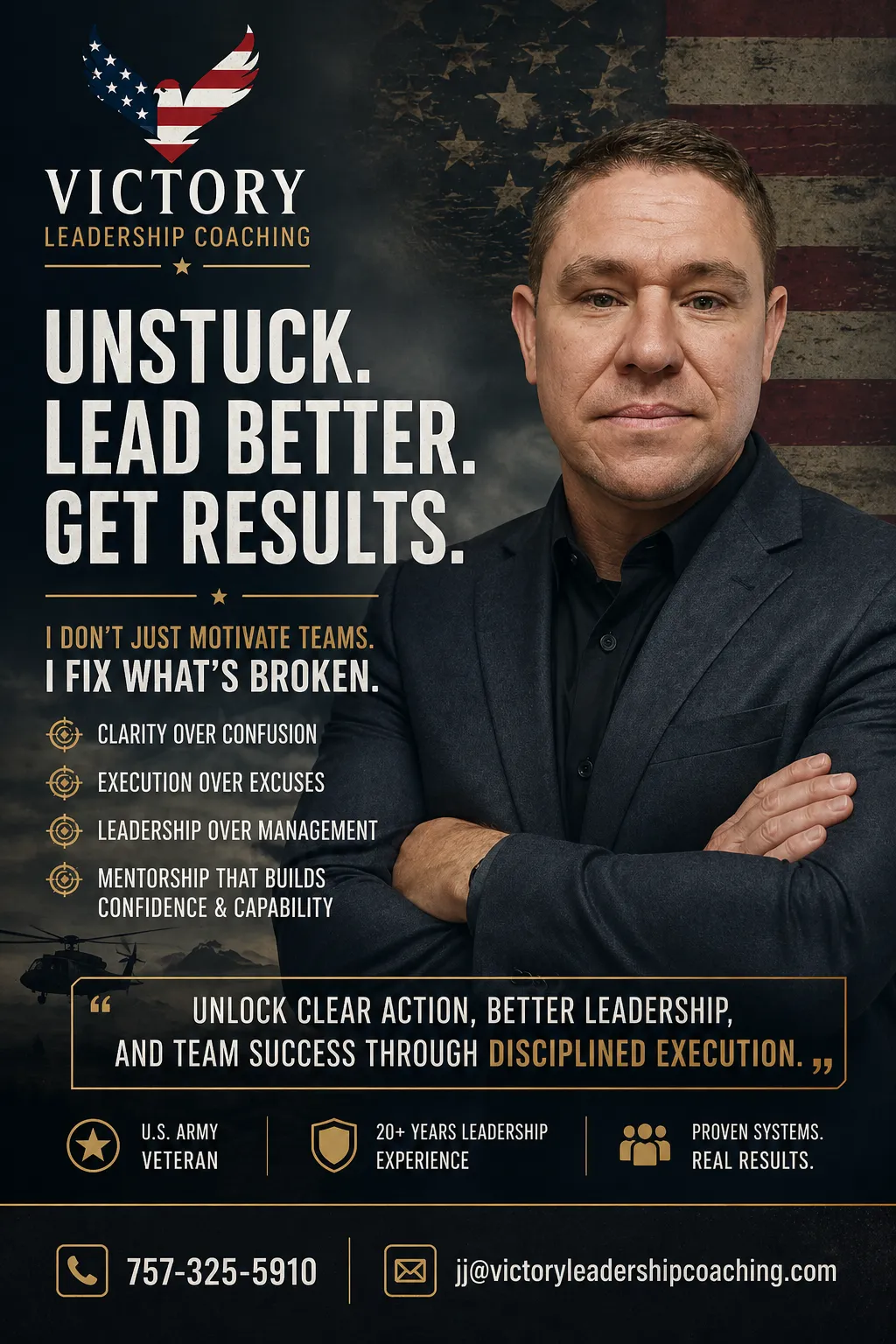
NOT SURE WHERE TO START?
Then I'll point you at the right one.
Clear next step in minutes.
Victory Leadership Coaching
© 2022 Victory Leadership Coaching. All rights reserved.